Tuesday, September 9, 2008

The Complexities of Wind Energy

Last week we commented on some of the potential problems of implementing Wind Energy. The idea is to illustrate the complexities behind developing and implementing these new technologies (Greentech).

This week we will try to illustrate the challenges of building an efficient wind turbine. THE POINT IS TO SHOW WHAT IS BEHIND THESE TECHNOLOGIES THAT SEEM SIMPLE, BUT ARE MUCH MORE COMPLEX ONCE YOU START DIGGING INTO THE DETAILS.

Before we start talking about the challenges of each component and type of turbine, the first issue pertains to the wind.

The efficiency for a single turbine or for a wind farm (multiple turbines) is a combination between turbine design and wind "quality". The wind quality is measured in terms of speed, air density, roughness (air flow affected by earth's surface or obstacles). All these factors have to me monitored throughout at least one year before deciding on turbine type and design. The reason is that the power obtained by a turbine is measured according to this formula:
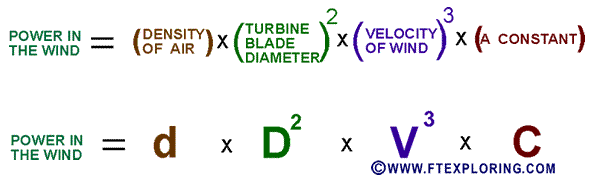
Wind power formula

(source http://ftexploring.com/energy/wind-enrgy.html)

Where (as you can see) the wind velocity affects the power output by a power of 3 (double the wind = eight times more energy output)

Furthermore, each turbine is designed to work under a specific wind speed. If the speed does not match the target for the design, the efficiency of the systems drops.

These are wind maps of Europe (red is strongest wind):

Wind Map of western Europe

and USA:

image

Assuming we find a great spot for our turbine and that the conditions will not change much from one year to the next. Now we have to decide on the type of turbine we would like to install.

Nacelle

As shown in the picture (for in-depth knowledge go to http://www.windpower.org) the basic elements of a turbine are: the rotor blades, the gearbox and the generator. These three components are at the top of the tower that has a rotating base (or yaw) to allow the blades to follow the wind's direction and the electronic equipment to control and monitor the turbine.

The rotor blades are a key component because their diameter affects the power output by the power of two (see power formula above). Also, the blades are the main element on the aerodynamics of the turbine. If the blades have poor design, the turbine will work only under a short range of wind speeds and types and it will reduce the force transmitted to the gearbox and therefore reduce the electric output. One of the biggest challenges of today's turbine design is the minimum speed at which they can generate power, the lower the speed the more these turbines will be generating electricity non-stop and the more sites will become feasible for wind farms.

The electric output of these turbines has to be compatible with the electricity we use at home (the one coming from the grid). This electricity has a frequency of 60Hz (50Hz in Europe). This means that the generator shaft has to rotate at approximately 1500 rpm, whereas the blades of the turbine rotate at around 30 rpm.

To solve this issue all turbines have a gearbox. The gearbox converts the slow rotation of the blades into a constant and faster rotation speed for the generator.  Otherwise, the generator should have a mechanism to "smooth" the  power peaks and therefore lose power in the process.

Finally we get to the generator which converts the mechanical force into electrical output. There are several options for these generators, from the number of coils (or magnets), their capacity to the option of having synchronicity or asynchrony between the shaft and the poles.

After all this is studied and budgeted we still need to add the size of the tower and its foundation strength as well as the weight of the whole system as it relates to the "yaw" (the mechanism that allows the turbine to rotate 180 degrees over its horizontal axis to follow the direction of the wind)

Power output & rotor diameters (rotor size vs power)

And to finalize our assembly we need to have all the components monitored by electronics. Some components (depending on the design) need to be adjusted according to the monitoring system. The output has to be measured as compared to the wind measurements to account for the efficiency of the turbine. And safety mechanisms (such as mechanical brakes) have to be provided for extreme winds, electric peaks, and component failure.

32 m rotor blade

At the end of the day the most efficient turbine is the one that provides most electricity per cost of its components times their working life. Keep in mind that wind is free, the cost comes from turbine components and their replacement cost (and perhaps also the land where they sit).

As you can see these technologies that seem straightforward at the beginning are much more complex when you get to the "nitty-gritty". The good news is that we are on a steep learning curve and sooner rather than latter we will get to a point where most hurdles will be left behind.

Until next week! SHALOM

Tuesday, September 2, 2008

Wind Energy

We can't talk about Wing Energy (also known as Eolic Energy) nowadays without talking about T. Boone Pickens and his plan.

The Pickens Plan (http://www.pickensplan.com/ - watch the video presentation) is an energy policy proposal announced July 8, 2008. Pickens' intention is to reduce American dependency on foreign oil imports by investing approximately US$1 trillion to build vast wind turbine farms for power generation, and then shifting the natural gas used for power generation to fuel automobiles.

This is a great move by Pickens, but it has some potential (and very critical) problems, which follow:

1- Problems with the grid (for more on this see the NY Times article). It turns out that all this electricity generated by wind turbines needs power lines to get distributed to the places that need it. The power lines (or power grid) in the US are getting old and have not had an overhaul in quite a while, and like any other equipment that is old and has not been renovated is facing serious breakdowns.

2- Mr. Pickens plan to substitute natural gas for vehicle imported fuel has some downfalls too. Natural gas is better used to provide backup to wind power, not to power cars. Natural gas is burned far more efficiently in power plants than in internal combustion engines. It would be more efficient to generate electricity from natural gas and then power electric cars. Also keep in mind that Natural Gas in non-renewable and is not 100% clean.

3- The plan also has possible ethics dilemma. According to an article in Popular Mechanics, if the plan is accepted, Pickens stands to reap a significant profit by building pipelines to pump billions of gallons of water from an aquifer under the Texas Panhandle, which he has bought the water rights to. The pipeline would follow the same 250-mile corridor that the wind farm would be on, which would be seized from private owners through eminent domain and granted to him. Pickens owns more water than anyone else in the U.S. However, according to Pickens, "I'm 80 years old and have $4 billion. I don't need any more money."

4- Subsidies, government funds… same old. Is there ever a true business model (without having to involve government money)? The CATO Institute (an organization co-founded by Charles Koch, a co-owner of Koch Industries which is the largest privately held oil company in the U.S, and funded by companies including Chevron, ExxonMobil, Shell Oil, Tenneco Gas and Amoco) claims that instead of allowing the market to work, Pickens wants government to limit imports of foreign oil along with installing the wind plants so that he can become richer at the expense of consumers. He also says that if wind power were a sensible economic investment, then it would not require the "lavish federal and state subsidies already in place or the additional largesse sought after by Mr. Pickens."

On the other hand…maybe these are Lobbyist acting on behalf of Big Oil, to protect their turf!

ASSUMING ALL OF THE ABOVE IS DISMISSED OR RESOLVED

There are some serious technical challenges for today's wind turbines.

Even though wind turbines (or wind generators) are widely used around the globe (more so in Europe than in America). The existing turbines are far from efficient and some wind farm profitability models are based on government funds. The promise for a next generation of turbines is the solution to increased profitability and lower barrier to entry into the Wind farm market.

How efficient are Wind Turbines?

There are several ways in which a turbine loses its efficiency.

1- There is a fundamental law of physics (Betz Law) which states that the best that could be achieved by a wind turbine is around 59% efficiency. This is due to the fact that if you take ALL the energy from the wind coming into the turbine you should have zero wind speed exiting from the turbine, which is an impossibility (there has to be a FLOW of wind to keep the propellers rotating)

2- Wind Speed: Wind Turbines are designed to be most efficient at certain wind speeds. As we all know (especially here in Florida) wind is very unpredictable. Therefore, today’s turbines lose efficiency because of changes in wind speed.

3- To generate power that can be used by today’s appliances or injected into the electric grid, the turbine has to generate electricity at a constant frequency (60 hertz in the US – 50Hz in Europe) and certain voltage (120 Volts in US – 230V in Europe). In order to achieve this rotor speed has to be “converted” to a constant speed (1500 rpm) and maintained this way throughout the operation of the turbine. This causes loss of efficiency in the speed conversion process as well as in the “monitoring” process (to ensure constant speed).

When all these losses are figured in, you might, if you are lucky, be getting 35% or so of the wind's energy actually delivered as useful electrical energy to the end user in the very best conditions. The average might only be in the twenties.

In the future we will talk about the different types of wind turbines and how each one takes a step closer to maximize efficiency. Until then, SHALOM!

Wednesday, August 27, 2008

The Gold at the end of the Rainbow

What makes Greentech such an obvious opportunity for me is (a)knowing that the solutions for today's energy, water and waste management problems are within reach, and (b) a lack of worldwide effort to reach for those solutions. In other words, we could (as citizens of the world) decide that regular (incandescent) bulbs should be phased out and use fluorescent bulbs instead. The numbers make an overwhelming point, using a fluorescent 60 watt bulb would save you:

10 light bulb changes
$40.50 in electricity costs
$1.50 in bulb replacement costs
$42.00 in total
Reduce greenhouse gas produced by power plants by: 691 pounds of carbon dioxide

(source http://www.ajdesigner.com/fl_light_bulb/light_bulb.php)

So why are we not doing this obvious things?. Why are governments not taking steps to regulate towards these solutions?

The answer lies within the business opportunity of greentech. People follow the laws of Newton Physics "Every object in a state of uniform motion tends to remain in that state of motion unless an external force is applied to it". Its easier to keep buying the same bulbs, its also easier NOT to make the calculation and decide on the cheaper bulb vs the more expensive one ($0.50 for the regular bulb vs $3.50 for the fluorescent). Another factor is the slow reaction of governments, it takes too much time for them to "enforce" the elimination of incandescent bulbs, perhaps there are many powerful interests involved or its not a law that would generate enough popularity. Either way, my "bet" is that in the near future ALL light bulbs will be fluorescent or some other new technology, because a trend with strong "external forces" is causing the "uniform motion" to change.

We already discussed some of these "external forces" that are bringing greentech about in The Greentech Wave (1-People are changing their attitude, 2-Companies are channeling resources to greentech, 3-Major economic players are influencing the market). All of these are responses to economic or sociopolitical trends that are causing the scales to tip towards greentech. In the case of the light bulb: the cost of electricity has jumped - in the US - by 33% since the year 2000, and is expected to raise even more as fuel costs climb and the electric infrastructure gets older. When those variables become a stronger "external force" then whoever is better positioned to provide these new technology bulbs to the market will benefit immensely. AND THAT IS THE GREENTECH OPPORTUNITY!

In the case of the light bulb, General Electric has already taken the steps to ensure they are also THE manufacturer of fluorescent bulbs. But there are many other areas of greentech where the market leadership is up for grabs. We will talk about these areas of opportunity in the near future. For now, as always I bid you farewell with a cordial "Shalom!".

Related Posts Plugin for WordPress, Blogger...