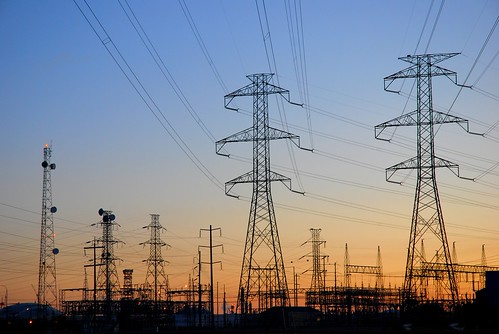
First of all I would like to thank everyone for responding to my Electric Grid Questions and throwing light into this subject which I find fascinating. Here is the compiled version of the answers I received for the first of the three questions plus some research of my own (the other two questions I hope to address in the upcoming weeks):
1- What is the best strategy for the future of power? Is it to generate electricity in each home, or neighborhood, or community; or to maintain the current system where a series of big power plants inject their product into a complex network that distributes the electricity to large geographic areas?
To help me answer this question I turned to Amory B. Lovins' newest article "Does a Big Economy Need Big Power Plants?" (it turns out we both wrote about this particular subject at the same time, therefore proving that great minds think alike!)
Amory is 100% for distributed power: “Central thermal stations have become like Victorian steam locomotives: magnificent technological achievements that served us well until something better came along.”
Some interesting facts mentioned in Amory's article: "The U.S. lags with only about 6 percent micropower: its special rules favor incumbents and gigantism. Yet micropower provides from one-sixth to more than half of all electricity in a dozen other industrial countries. Micropower in 2006 (the last full data available) delivered a sixth of the world’s total electricity (more than nuclear power) and a third of the world’s new electricity. Micropower plus “negawatts” — electricity saved by more efficient or timely use — now provide upwards of half the world’s new electrical services. The supposedly indispensable central thermal plants provide only the minority, because they cost too much and bear too much financial risk to win much private investment, whereas distributed renewables got $91 billion of new private capital in 2007 alone"
Even though I would also prefer to see a distributed power system I am not as optimistic as Mr Lovins (and neither were some of the people who responded). There are some important efficiency and market issues with distributed energy generation that we have to face right now. Take wind power for example: the newer generation of wind farms has more and bigger turbines than their predecessors. I credit this to several factors:
- Turbines become more efficient as they grow in size - bigger turbines (this is true up to certain limits)
- Wind farms benefit from economies of scale as they become larger (more turbines)
- As wind farm owners become more comfortable with the investment, higher capacity plants are being proposed and funded.
- Most important of all: Selling and installing ONE wind farm that produces a Mega Watt per hour is easier (and more commercially viable) than selling thousands of smaller kilo watt turbines. This point in particular affects the whole chain of development of power plants:
- 1. Developers of new technologies aim towards bigger pockets (centralized plants). Therefore, creating newer and more efficient generators for the centralized system and neglecting the distributed option.
- 2. Investors, distributors and installers aim to reduce their risk by concentrating their investment and effort into more focused and less mass market trend-changing technologies. When we talk about creating a new wind power plant, we understand the limits and the risks better than if we would talk about selling wind turbines door to door.
The same efficiency and market issues hold true for other renewable energy generation methods (with perhaps the exception of solar PV, being the one with the most distributed systems to date). Furthermore we are leaving hydro and nuclear out of the equation. Forget the impossibility of having distributed hydro power and the danger of having distributed nuclear power!
Finally, I am including some answers I received via email or LinkedIn (I am reserving the names of the authors awaiting for their approval):
· "we need to break away from centralized power...and as it happens - while that's not a common opinion with the big power companies - it is the common opinion of electrical generation engineers"
· "technology and wisdom will dictate the answers...Now that science is finally focusing on the problem of sustainability and innovation, breakthroughs will be coming within a few years based on existing "future-tech" inventions and unimagined ones"
· "With the move to wind and solar power it will be necessary to maintain a large grid system because of the instability of the energy production"
· “I think the "smart grid" has the potential in the 2010s to duplicate the same type of transformation of our everyday lives as did the Internet in the 1990s… New technologies are making small generating facilities (solar, wind, biomass, even natural gas) sufficiently economic that they can compete with the large central station generators… The smart grid can help here also. It will be able to control the micro generating device you install at your house. When you are away or not otherwise using your full capacity for your own house, the smart grid will pump your electricity into the grid for others to use. This lets your system operate on a useful basis closer to 100% of the time with the resulting efficiency gain”
· “the best strategy isn't a single approach. By combining efficiency at the demand end of the grid (homes, business, etc) and allow the demand to sell the ability to reduce further during peak periods we can avoid building some amount of new generation. This alone isn't enough. Technology on the supply side with newer more efficient means of generation also play a role”
· “Imagine rental properties or tightly packed suburban neighborhoods. These folks would find it difficult if not impossible to erect a wind turbine or solar panel. Also, many consumers would not be able to generate enough alternate source power individually to run their homes and most businesses would not either”
· “Think how consumption is accomplished - locally in homes and local businesses, and there are some large energy intensive industries that require huge amounts of energy, like metal foundries and smelting, and they need the massive generation power of wind farms and solar farms and hydro dams (for overnight storage, and base load power)”
· “Part of the problem with local generation is that no one wants to live next to a power plant”
· “Electricity tends to be a natural monopoly. Established industrial groups especially the utilities owning and operating generating stations on fossil fuels and large dumb grids and super highways supplying energy at low tariffs were hitherto getting away with murder by not paying for externalities (carbon footprint increase).”
· “for most sources local generation is impractical, and you still need a grid to even out supply and demand even for solar”
· “The moving of energy from point A to B, and often back again, is a huge drain on efficiency. Keeping it all close by to where it was generated and will be used would be great. However are there good options for the consumer and/or the business that want to store the power? I've read about some custom hydrogen fuel cell methods. There is always batteries I guess”
Until next week…SHALOM!